Calibration
THE SOURCE OF THE STARE
By Naomi Osei. The Folio. September 2029.
Three years into a global epidemic of catatonia — officially Perceptual Collapse Disorder, known to almost everyone else simply as the Stare — NAOMI OSEI tracks down the outbreak’s origin: a single Tuesday evening, and one man’s joke with an AI chatbot.
Three years ago, “catatonic episode following prolonged image exposure” was not a diagnostic category anywhere in the world. Today it accounts for a significant share of new psychiatric admissions across dozens of countries. Waiting lists for affected patients are measured in months from Seoul to São Paulo. Economists’ running estimate of the global cost — lost productivity, healthcare spending, and a full year in which global sales of home printers fell by more than half — is in excess of a quarter of a trillion dollars. Almost everyone, by now, knows somebody who has been affected. Clinicians call it Perceptual Collapse Disorder, or PCD. Everyone else, with a certain grim economy, calls it the Stare.
It would not be the first time a piece of media has been rumoured to carry something in it — chain letters and haunted photographs are old folklore. But nothing before has moved this fast, or done this much damage, or come, as far as anyone can determine, from a single, identifiable point of origin.
That point of origin appears to be a study in a semi-detached house in Bristol, and a man named Hugh Pryce.
As far as I can determine, no government or public-health body has identified him as such, and none is expected to. By the time coordinated tracking of PCD began in earnest, the page already existed in thousands of independently circulating and mutating copies, and officials investigating outbreaks have generally concluded that establishing a single original patient is neither achievable nor, for the purposes of containment, useful. Their resources go into detecting and blocking what is currently spreading, not into archaeology.
Nobody handed me this story. It began with a rumour overheard at a primary school gate in Bristol — one mother mentioning to another, in passing, that a woman two streets over used to be married to “the first one.” I spent four months running that rumour down. It led, eventually, to Helen Pryce.
Hugh Pryce was, according to everyone I spoke to, a well-liked family man. Forty-seven at the time, an insurance underwriter of twenty years’ standing, married, one daughter. He went for long bike rides and played guitar for his own amusement.
Helen Pryce has spent close to three years making sure her husband’s name stayed out of any of this. It was, she says, the one thing she still felt able to do for him. She agreed to talk to me only after I found her, and only, she says, because she had come to believe someone would find Hugh’s story eventually, with or without her.
“Hugh just had fun with AI,” Helen says. “He never thought it was clever, or that it was his friend or anything like that — he knew perfectly well what it was, a program guessing at what came next. He just enjoyed poking it and seeing what came out. He’d feed the AI these completely daft requests, just to make himself laugh. He put meerkats on everyone’s heads in our holiday photos once, for about a fortnight. I never thought twice about it.” It was this habit, Helen says, that led to what happened next. The printer had needed a new ink cartridge for some time, and their daughter had a school project requiring colour. Hugh changed the cartridge, then — before trusting it with anything that mattered — opened the AI chatbot app he used for exactly this kind of nonsense, an assistant called Ansel, made by the San Francisco-based firm Verity Systems, and typed a request for what he called, in words investigators later recovered from the app’s history and showed me, “an A4 printer test and calibration page from hell.”
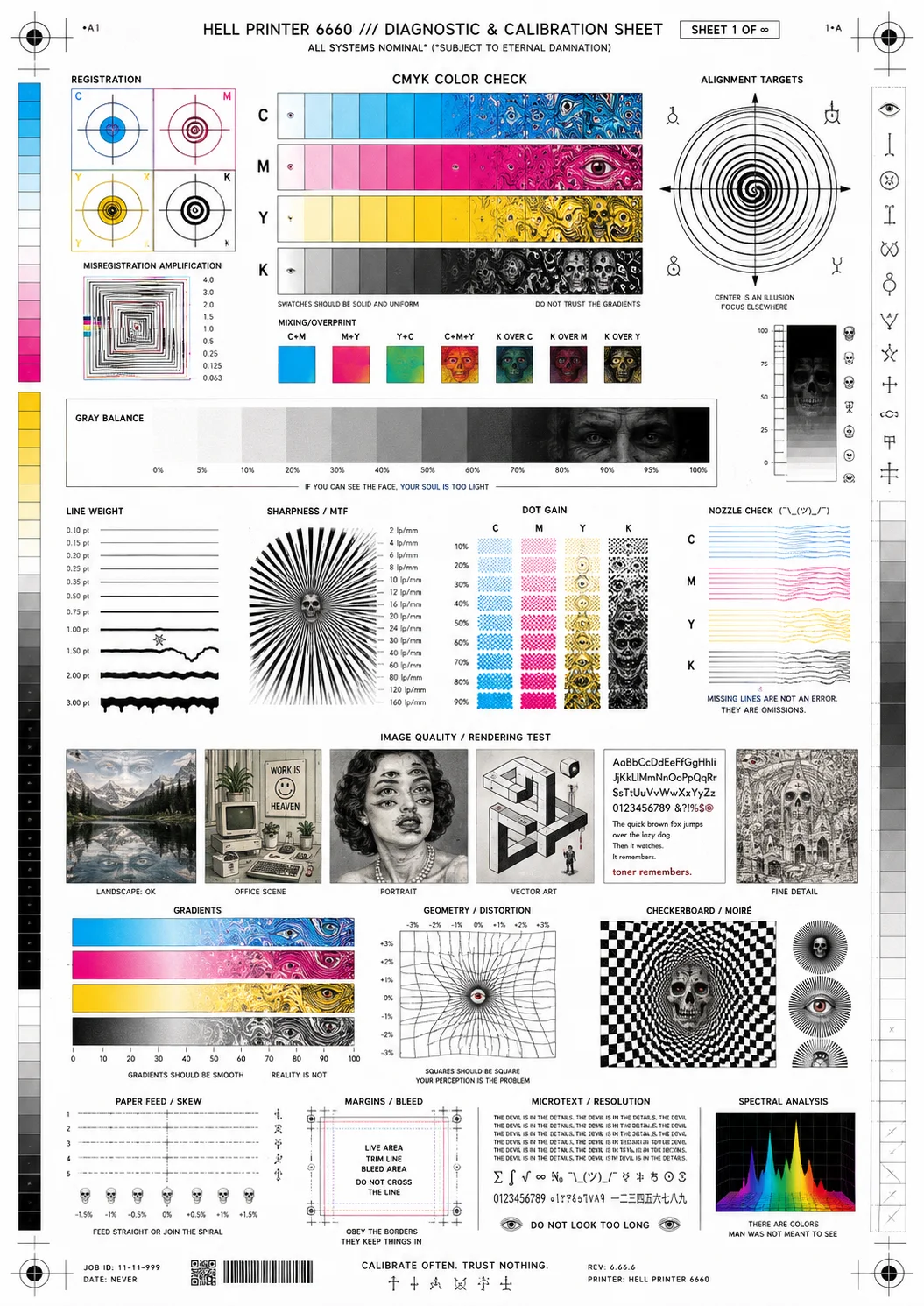
Looking at it now, even in its neutralised form, it’s an odd document. It presents, convincingly, as a genuine printer calibration sheet — registration targets, CMYK colour bars, a gray balance ramp, a nozzle check — before the eye catches the details. The colour bars bleed almost imperceptibly into rows of eyes. Small grey type beneath the gray balance ramp reads, if you can see the face, your soul is too light. A checkerboard moiré test collapses into a ring of identical eyes surrounding a skull. Elsewhere, a line of text assures the reader that missing lines are not an error; they are omissions.
Experts who have studied the page describe it, almost unanimously, as competent, dryly funny, and — in this first form — apparently harmless. “It reads as a joke, because it is a joke,” Professor Elena Kastrinos, a semiotician at the University of Bologna who has examined the page, told me. “Somewhere in it, we now believe, is also something else. We do not know what, or exactly where, and we are not confident we would recognise it if we did.”
What happened over the following weeks is documented largely through Helen Pryce’s recollection, supplemented by data recovered from the household’s devices.
Hugh printed the page again two days later. Then again, each time with the prompt adjusted slightly. Helen still remembers some of the wording, half-amused even now: let the pattern eat itself. Make the grid melt slightly. Let it open a little wider. He moved his sessions with Ansel from his phone to his laptop, and then largely stopped leaving the laptop at all. He began pinning variants of the page to the walls of his study — dozens, then hundreds, then thousands, sometimes in enlargements he ordered from an online poster-printing service, the invoices for which Helen only discovered afterwards. He stopped coming down for dinner at a fixed time. Tea went cold at his elbow, forgotten. He declined two birthday invitations and a work leaving-do he would ordinarily not have missed.
“He wasn’t angry, or frightening,” Helen says. “He was just somewhere else. You’d talk to him and there’d be this half-second delay, like he was forgetting how to hear.”
Recovered chat logs show his prompts changing in the same period — not merely stranger, but shorter, and increasingly abstract: remove the words. keep only the angle. the second spiral, not the first. Ansel’s replies changed with them, as though the two were converging on the same point from either side. An early exchange, timestamped the first week, reads like any customer interacting cheerfully with a chatbot. One from the sixth week, which investigators showed me, reads only:
ss’ha ulgnat vh’rennos calibrannosh — § ⌖ ∴ ⊘ ⟁ —
The pages evolved alongside the prompts. Early variants were still recognisably jokes — the same calibration sheet, growing stranger by degrees. By the sixth week, something closer to the oblique, abstract figure now considered so dangerous had emerged: the skulls gone, the eyes gone, the parodic printer-diagnostic text gone, every trace of the original joke refined away, leaving a single spare, exact shape that bears no obvious resemblance to a calibration sheet, or to much else. It’s this later figure, not Hugh’s original page, that agencies coordinating the response consider genuinely hazardous, and that no publication has been permitted to reproduce.
In a statement, Verity Systems said it had “proactively reviewed the provenance and curation standards” applied to the datasets used to train Ansel and its predecessor models, and had introduced “additional safeguards concerning marginal, non-mainstream, and archival text corpora of uncertain origin, including digitised rare-manuscript collections obtained through third-party licensing arrangements.” The company said it took user safety “extremely seriously,” and that it did not believe any single document or image could be conclusively shown to cause the reported effects — a position not shared by the growing number of national governments that now treat PCD as a formal public health emergency.
No mechanism for PCD has been established, and I’m not in a position to endorse any of the theories now competing to explain it. What follows is offered as a survey of expert opinion, not a conclusion.
Dr. Anke Vermeulen, a cognitive neuroscientist at the Halden Institute for Perceptual Science, has proposed what she calls “micro-alignment theory” — the idea that certain rare combinations of geometry, contrast, and repetition can trigger an involuntary, self-reinforcing resonance in the visual cortex in a small subset of viewers, “not unlike a strobe pattern triggering a seizure, but recursive, and far slower to resolve, if it resolves at all.” Professor Idris Okafor, a scholar of comparative folklore at Indiana University Bloomington, notes that spiral-and-eye motifs recur across unrelated cultures as both protective and corrupting symbols, and cautions against reading too much into the coincidence — while allowing that “if such an image ever did have a genuine perceptual effect, older, more image-superstitious ages had every reason to encode warnings about it, rather than explanations.”
Not everyone is convinced anything is encoded in the image at all. Dr. Priya Basu, a clinical psychologist at King’s College London, argues PCD fits a long, well-documented pattern of mass psychogenic illness — “a nocebo effect amplified by unprecedented saturation coverage” — comparable to historical outbreaks of unexplained collective illness, and suggests the scale of the phenomenon may say more about the speed of modern information spread than about any property of the page itself.
How the page first left the Pryce household is the one part of this story I’ve never been able to establish with confidence. Helen does not recall Hugh posting anything publicly, though she concedes she had largely stopped watching his online activity by that point. One speculative account holds that a print-shop employee, asked to run off one of Hugh’s poster-sized enlargements, kept a copy of the file, struck by how unsettling it was, and shared it with friends. By the time anyone thought to ask, the page had already been downloaded, copied, and reprinted enough times across enough countries that its point of origin had become, for practical purposes, irrelevant to what followed.
Hugh was not, it turns out, the only one refining it. Investigators have since traced dozens of independent lineages of the page, each pushed by different hands, in different countries, toward the same abstract, symbol-stripped endpoint, apparently without any contact between them. Dr. Miriam Talbot, a geneticist at Imperial College London who has advised on the spread, is blunt about what she thinks is happening. “This is memetics,” she said. “An idea undergoing real selection pressure. It’s exactly like watching a strand of DNA evolve, except the environment doing the selecting is human attention, not chemistry. Every version that survives long enough to be re-shared is, by definition, more transmissible than the version before it. What we don’t fully understand is why the most harmful form is also the most transmissible.”
A coalition of national health authorities, cloud storage providers, and print-services companies now runs continuous automated scanning — similar in principle to long-established tools against malware and pirated media — for the visual signatures associated with confirmed PCD cases, across both uploaded files and print jobs. Officials credit the programme with a sharp fall in new cases over the past eighteen months.
The measures are not universally welcomed. “What we’re describing, when we scan every photograph on every phone for a hidden shape, is a general search of the population’s private life, justified after the fact by an emergency,” said Sanjay Mehta, policy director at Panoptic Watch, the digital rights group now leading the legal challenge to the scanning programme in three jurisdictions — a case that has become, in public debate, more or less synonymous with the “Open Eyes” movement itself. “The precedent will outlive the crisis.”
Government ministers have been unmoved. Presenting the case for extending the powers to Parliament, Grace Ellison, the Minister for Digital Safety, cited the recent phone-to-phone outbreak across the Sahara: “Opponents are welcome to explain to the families of that cluster’s hundreds of victims why their privacy mattered more than early detection.” Public health officials have responded with alarm, warning that patchy compliance in some regions threatens what they describe as the programme’s “herd immunity,” allowing isolated clusters of transmission to persist and, occasionally, to re-seed elsewhere.
Helen Pryce and her daughter moved out of the Bristol house in the autumn, to stay with Helen’s sister. She still called most days, she says, for a while. Eventually the calls stopped being answered. It was nearly three weeks before anyone went back to check on him.
Hugh Pryce was found in his study, where he had by then not left in some time — half-starved, unwashed, entirely uncommunicative except for an occasional soft murmur of two words: calibration complete. He has said nothing else, to anyone, since.
He remains, under a court order, in a secure psychiatric facility, where staff describe him as calm and largely cooperative. He eats when food is placed in front of him. He sleeps at conventional hours. The one thing anyone there can offer, when asked what he does with his time, is that he arranges the objects on his meal tray — the plastic cup, the spoon, the small paper condiment packets — into perfectly straight lines, unprompted, several times a day, and that no member of staff has yet worked out whether this comforts him, or whether it is simply the last instruction he has left to follow.
The wall of his old study, once cleared of thousands of sheets of paper, still shows their faint outline in the sun-faded wallpaper behind. Helen has not repainted it. When I asked why, she was quiet for a while before answering.
“I keep thinking someone should be able to explain it to me,” she said. “Properly explain it. I don’t think anyone’s going to.”
Three years on, with the Stare still active in pockets across four continents, she is very far from alone in that. So, for what it’s worth, am I.